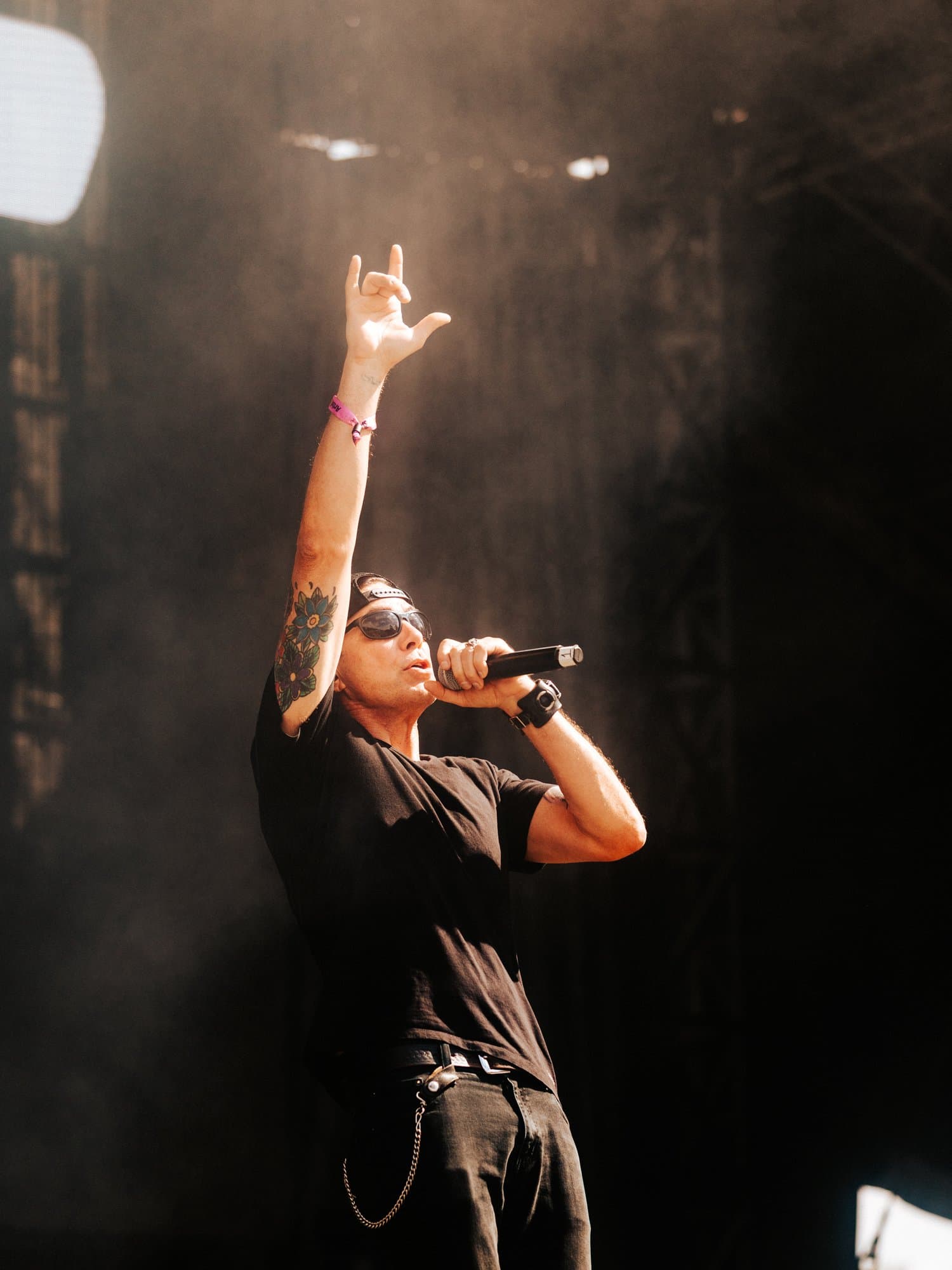
Oleander played the very first Aftershock in 2012. Fourteen years later they were back on home turf at Discovery Park, at a festival Doug Eldridge says is “about quadruple in size.”
The band that 98 Rock helped break in the late '90s isn't making albums anymore. Their last full-length was Something Beautiful in 2013. Instead they're putting out a new song every six to eight weeks, starting with the single “4th of July.” And they brought some of Sacramento's '90s scene along with them: Art Padilla of Hero's Last Mission played his first Aftershock with the band this year, and Dan Camacho of 7th Standard is in the lineup too.
At the festival, Thomas Flowers and Doug Eldridge talked with Sac Setlist about writing music before lyrics, papering Sacramento with flyers, the one club that would book them, and what 2027 looks like.
This interview has been edited for length and clarity.
You played the first Aftershock in 2012. How does it feel to be back home?
Doug Eldridge: It feels good. We played the first Aftershock back in 2012, and it's good to be back here. It's about quadruple in size.
I've been to every Aftershock. It was one day and one stage, and now it's four days and five stages. You have a new single, “4th of July.” Who wrote it?
Thomas Flowers: Well, we wrote it.
Eldridge: We collaborate on just about everything.
What comes first, the lyrics or the music?
Flowers: Typically it's the music, and then we figure out the lyrics afterwards. Listen, we had a song, “Down When I'm Loaded.” We played that thing for almost two and a half years, and I was mush-mouthing lyrics the whole time until we figured it out for the record.
What's the difference between mush-mouthing and being drunk?
Eldridge: There's not much difference.
Flowers: With me, there's not a lot of difference there, young man.
Your last album came out in 2013. Does the new single mean a new album?
Flowers: No, not a new album, but we're definitely going to be releasing songs about every six to eight weeks. That's just the new way it is. Which is actually cool, because we've got the songs. Instead of writing and releasing a whole album like we used to and going on tour for however long, now we go at our own pace: write, record, release and promote.
When you started in the mid-'90s, you had to put up flyers and beg people to come to shows. Take us back.
Eldridge: I was the man behind the flyers. I had a whole wall in my apartment with all our flyers, and all the killer staple guns. We used to go around putting flyers on cars and telephone poles, I'm sorry, distribution poles, until we got in trouble. You had to put in the work.
What was the first venue you played in Sacramento?
Flowers: Old Ironsides. It was the only club in Sacramento that would ever have us. Don't get me wrong, we tried, but nobody wanted us. Old Ironsides opened their doors and their hearts to us, and that was it.
It's still here. Would that be crazy if you just walked in tonight and asked to do a quick acoustic set?
Flowers: You know what would be even crazier? If we did a full-on show there, like, I don't know, next year. And I'm talking old school, where it sounds like shit. It's definitely a fire hazard. It's dangerous, because you don't know what Eldridge is going to do.
Eldridge: We played New Year's there. I remember the New Year's show. We had fistfights in the band. We were pretty disagreeable at times.
Fistfights?
Flowers: See, you can't mention that without her wanting to know about it. Let's just say that maybe me and our drummers haven't always gotten along. There was even a moment where me and my bass player didn't exactly get along, but that didn't go to fisticuffs, thank God, because I'd be dead today. The other guys, they punch like bitches.
What inspired “4th of July”?
Flowers: That's a really good question. I'll be completely honest with you: I was thinking about my relationship with Doug and my relationship with my wife. If you think about the lyrics, it's all about after all these years, and everything we've been through, waking up every morning and still knowing that you're there. It's the best thing ever. That's really what it was about.
Eldridge: I would like to clarify that those are two totally independent relationships, his wife and me.
How has the band changed in 30 years, in how you play and what the crowd can expect?
Eldridge: We write what we write. We are who we are. I suppose over the years there's been a metamorphosis. Maybe we're a little heavier at times, but we always find our way back to mid-tempo, good melodies. We write music that we like. That's all we can do.
Now that you're back at Aftershock, can we expect you around a while longer?
Flowers: We actually never went away. We just took a minute off. This is all about us doing things we enjoy, and right now we're having a great time. As long as it's fun, we're going to keep doing it. We have a lot lined up for next year, so 2027 should be a very enjoyable Oleander experience for people across the country and maybe even outside of the country.
How did Art Padilla from Hero's Last Mission end up playing with you?
Flowers: The '90s was a phenomenal time in Sacramento. We were one of many bands on the come-up, and Hero's Last Mission was one of my favorite bands. We had them on shows, I just loved them, and it was a natural choice for Doug and me to say, “Hey, do you want to be a part of this at this stage in our career?” There's another one, Dan Camacho from 7th Standard. Both of those bands should have been where we ended up getting to go. They didn't, so the best thing we can do is invite them in, and they make us a better band.
Watch the full interview on YouTube: Oleander at Aftershock 2026.
Photos: Steve Thrasher. Video: Sac Setlist.